

Biro Power migrates agritech workloads to AWS
A scalable AWS architecture enabling IoT connectivity, analytics, and AI workloads.
About The Customer

Biro Power Pvt. Ltd. is an innovation-driven agritech company focused on transforming India’s agriculture and rural infrastructure through intelligent IoT, automation, and data-driven insights. They were awarded as the Bihar’s start-up of the year. The company designs and deploys smart energy, irrigation, and post-harvest management systems to empower farmers, cooperatives, and energy partners with real-time monitoring, predictive control, and sustainable resource optimization.
Biro Power’s on-ground infrastructure includes a large ecosystem of IoT sensors, cameras, PoE devices, and edge controllers deployed across farms, solar installations, and food-processing environments. These devices continuously generate telemetry such as power usage, soil moisture, equipment performance, and environmental metrics
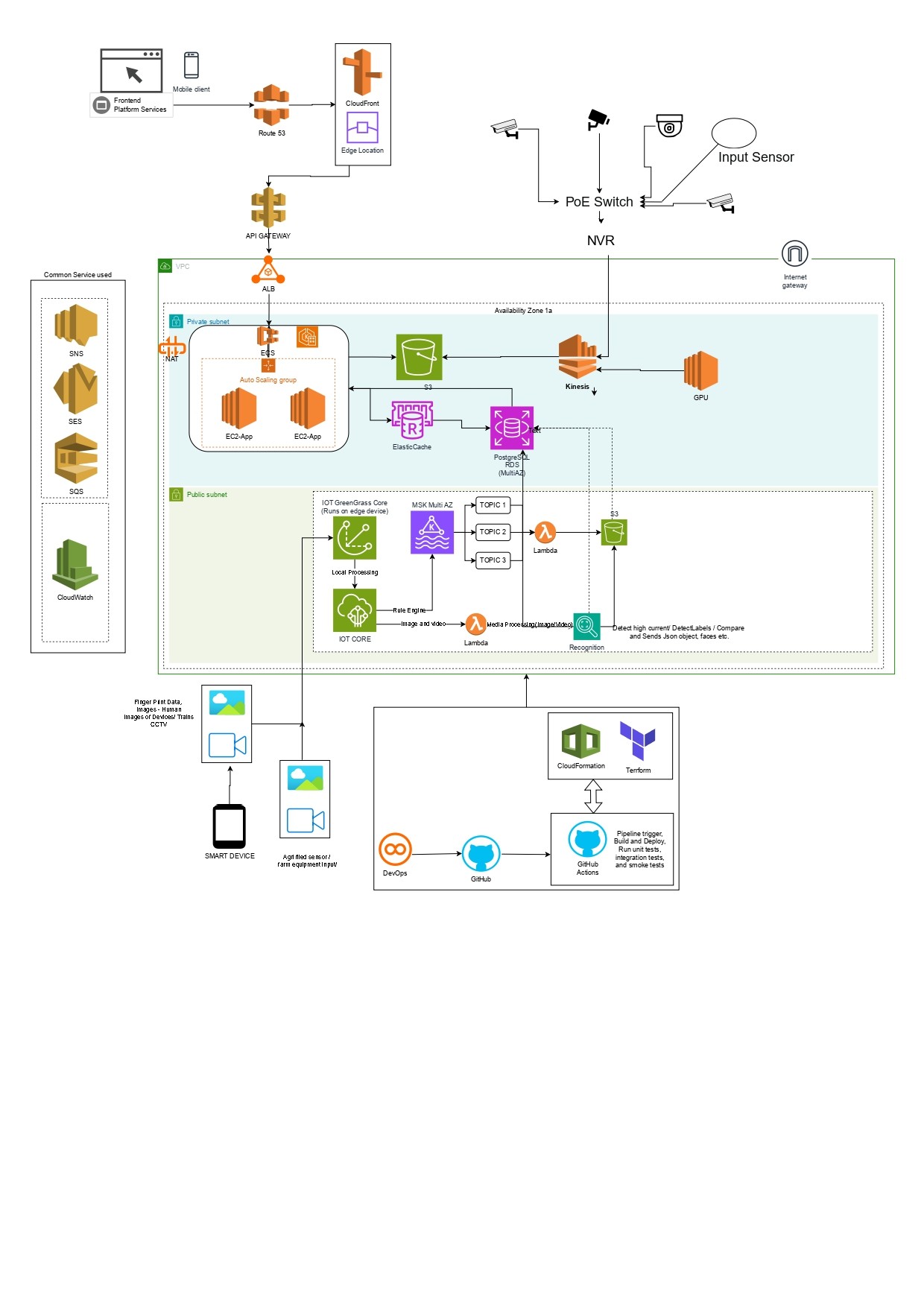
Architecture Diagram
Customer Quote
“Migrating our workloads to AWS has given us a scalable and reliable foundation to support connected machines, analytics, and future innovation.”
Rajnish Kumar Founder, Biro Power Pvt. Ltd.
Executive Sumarry
Biro Power Pvt. Ltd., an award-recognized agritech startup based in Patna, Bihar, faced scalability and operational challenges running IoT and analytics workloads on on-premises infrastructure. Sanrish assessed Biro Power’s existing environment and migrated core workloads to Amazon Web Services (AWS). The new cloud-native architecture runs in the Asia Pacific (Mumbai) Region and uses managed compute, database, storage, and machine learning services. This enables Biro Power to operate production workloads reliably while preparing for future scale across connected agricultural machines and data-driven insights.
Takeways
Challenges:
On-premises infrastructure limited scalability for IoT telemetry and analytics workloads.
AI and data workloads required flexible compute that was difficult to provision on-premises.
Operational visibility and centralized management were constrained.
Solution:
Assessed and migrated workloads to AWS using Amazon Elastic Compute Cloud (Amazon EC2), Amazon Relational Database Service (Amazon RDS for PostgreSQL), and Amazon Simple Storage Service (Amazon S3)
Enabled AI experimentation using Amazon SageMaker with GPU-backed instances.
Results:
Successfully migrated identified on-premises workloads to AWS
Production workloads operational in the Asia Pacific (Mumbai) Region
Established a scalable cloud foundation for future IoT expansion and AI workloads
Scaling IoT and analytics workloads beyond on-premises limitations
As Biro Power expanded its agritech solutions, the company began deploying smart agricultural machines, sensors, cameras, and edge devices across multiple field locations. These deployments generated continuous telemetry, image, and video data that needed to be processed reliably and securely. The existing on-premises setup struggled to support this growth. Provisioning compute resources for analytics and machine learning workloads was time-consuming, scaling storage and databases required manual intervention, and monitoring across distributed systems was fragmented.
In addition, many deployments operated in environments with unreliable connectivity, making centralized processing alone insufficient. Biro Power needed an architecture that could support edge processing, real-time ingestion, and centralized analytics while maintaining high availability and security. These limitations slowed experimentation, increased operational overhead, and constrained the company’s ability to scale connected machines and data-driven services.
Assessment-led migration to a cloud-native AWS architecture
The AWS Partner conducted a detailed assessment of Biro Power’s on-premises environment and designed a cloud-native architecture on Amazon Web Services (AWS) aligned with the company’s IoT and AI roadmap.
The solution uses Amazon Virtual Private Cloud (Amazon VPC) to provide network isolation, with public and private subnets spanning multiple Availability Zones. Application traffic is routed through Amazon Route 53, Amazon CloudFront, Application Load Balancer, and Amazon API Gateway, enabling secure and scalable access for web and mobile clients.
Core application workloads run on Amazon Elastic Compute Cloud (Amazon EC2) within Auto Scaling groups and Amazon Elastic Container Service (Amazon ECS) for containerized services. Amazon Relational Database Service (Amazon RDS) for PostgreSQL (Multi-AZ) provides managed, highly available relational storage, while Amazon ElastiCache improves application performance through low-latency caching. Object storage and media assets are stored in Amazon Simple Storage Service (Amazon S3).
For IoT workloads, the architecture integrates AWS IoT Core for secure device connectivity and AWS IoT Greengrass to enable local processing and rule execution on edge devices when connectivity is limited. Streaming telemetry and event data flow through Amazon Managed Streaming for Apache Kafka (Amazon MSK) and Amazon Kinesis, enabling near-real-time processing.
Image and video analytics are handled using GPU-enabled workloads and Amazon Rekognition, while backend processing and rule execution leverage AWS Lambda. Notifications and asynchronous workflows use Amazon Simple Notification Service (Amazon SNS), Amazon Simple Queue Service (Amazon SQS), and Amazon Simple Email Service (Amazon SES). Observability is centralized using Amazon CloudWatch.
Deployment and infrastructure management are automated through AWS CloudFormation, Terraform, GitHub Actions, and CI/CD pipelines, enabling consistent and repeatable deployments.
Designed for scalability, security, and operational efficiency
The AWS architecture provides Biro Power with a secure and scalable platform to run compute, database, IoT, and AI workloads. By using managed services, the company reduced operational complexity while improving system reliability. Multi-Availability Zone deployments, managed databases, and built-in monitoring support production readiness as usage increases. The design allows Biro Power to incrementally scale devices, data volumes, and analytics workloads without re-architecting core systems.
Supporting AI and data-driven innovation
By running workloads on AWS, Biro Power can provision compute resources on demand and test new analytics and machine learning capabilities without large upfront infrastructure investments. GPU-backed workloads enable image and video analysis use cases such as equipment monitoring and anomaly detection, while streaming services support real-time insights from connected machines. This flexibility allows teams to iterate faster and validate new use cases before scaling them into production.
Business outcomes and next steps
Following the migration, Biro Power successfully operates its production workloads on AWS in the Asia Pacific (Mumbai) Region. The new environment improves operational visibility, simplifies infrastructure management, and enables faster experimentation across IoT and AI workloads. With a scalable cloud foundation in place, Biro Power is positioned to expand connected agricultural machines, enhance data-driven services, and introduce advanced analytics as adoption grows.